
Product Description
APAR’s Aluminium Conductor Composite Core (ACCC®) is an advanced High Temperature Low Sag (HTLS) conductor designed to deliver superior electrical performance, higher ampacity, and significantly lower sag compared to conventional ACSR conductors. Utilizing a lightweight hybrid carbon and glass fiber composite core, ACCC® conductors offer exceptional strength-to-weight ratio, improved conductivity, and enhanced corrosion resistance.
Designed for transmission line uprating and grid modernization projects, ACCC® conductors enable utilities to increase power transfer capacity while utilizing existing transmission infrastructure, making them an ideal solution for growing energy demand and renewable energy integration. APAR also offers ACCC® AZR conductors for snow-prone areas.
Key Advantages
- High Temperature Low Sag (HTLS) conductor technology
- Continuous operating temperature capability up to 180°C
- Higher current carrying capacity compared to conventional ACSR conductors
- Lowest sag among HTLS conductor technologies
- Lightweight construction with excellent strength-to-weight ratio
- Lower electrical losses and improved transmission efficiency
- Superior corrosion resistance compared to steel-core conductors
- Increased transmission capacity using existing infrastructure
- Reduced tower loading due to lighter conductor weight
- Long service life with minimal maintenance requirements
- Grid Vista core enables continuous real-time monitoring of critical parameters such as conductor temperature, strain, sag, vibration, ice loading, and hot spots
Available Variants
APAR offers ACCC® conductors in multiple sizes and configurations to meet utility and project-specific requirements. ACCC conductors are also available with Infocore, ULS (Ultra Low Sag) core, and Grid Vista Core.
The conductor design can be optimized based on ampacity, mechanical loading, span requirements, and transmission voltage levels.
Applications
- Transmission line uprating projects
- High Temperature Low Sag (HTLS) transmission systems
- Utility grid modernization programs
- Renewable energy evacuation networks
- Long-span transmission crossings
- Urban and congested transmission corridors
- Capacity enhancement of existing transmission lines
- New transmission infrastructure projects
- Industrial and utility power networks
- Smart grid and future-ready transmission systems
Standards & Quality
APAR’s ACCC® conductors are manufactured and tested in accordance with internationally recognized standards and customer specifications to ensure superior electrical and mechanical performance.
Each conductor is manufactured through very stringent quality standards, with rigorous testing at every stage including type testing and validation.
Construction & Material
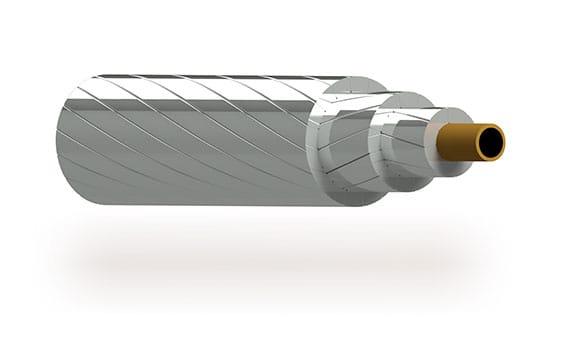
ACCC® conductors consist of fully annealed trapezoidal-shaped aluminium wires concentrically stranded over a hybrid carbon and glass fiber composite core.
The composite core provides exceptionally high strength with very low thermal expansion characteristics, significantly reducing conductor sag under elevated operating temperatures.
The outer layers comprise 1350-O tempered aluminium wires with superior conductivity, maximizing aluminium content within the conductor diameter and resulting in superior electrical conductivity and lower transmission losses compared to conventional conductors.
This advanced construction enables increased power transfer capacity while maintaining excellent mechanical and thermal performance.
APAR’s Design & Manufacturing Expertise
With extensive expertise in advanced conductor technologies and transmission infrastructure solutions, APAR delivers high-performance HTLS conductors engineered to meet the evolving needs of modern power networks.
Our manufacturing capabilities ensure:
- Precision composite core integration
- Advanced aluminium wire processing and stranding
- Consistent electrical and mechanical performance
- Superior sag and thermal characteristics
- Rigorous testing and quality assurance
- Compliance with global utility standards
APAR’s ACCC® conductors help utilities improve grid reliability, increase transmission capacity, reduce losses, and maximize the utilization of existing transmission assets.