
By Saurabh Mahajan, Global Sales Head, Conductors, APAR Industries Limited
India’s power sector is undergoing a dynamic transformation driven by the twin imperatives of energy efficiency and grid reliability. With accelerated capacity expansion, greater integration of renewables, and modernisation of transmission and distribution systems, the need for efficient transformers remains paramount. While transformers themselves are critical to the power system, the importance of their components — particularly conductors — is even greater, as they directly influence performance, efficiency, and operational reliability.
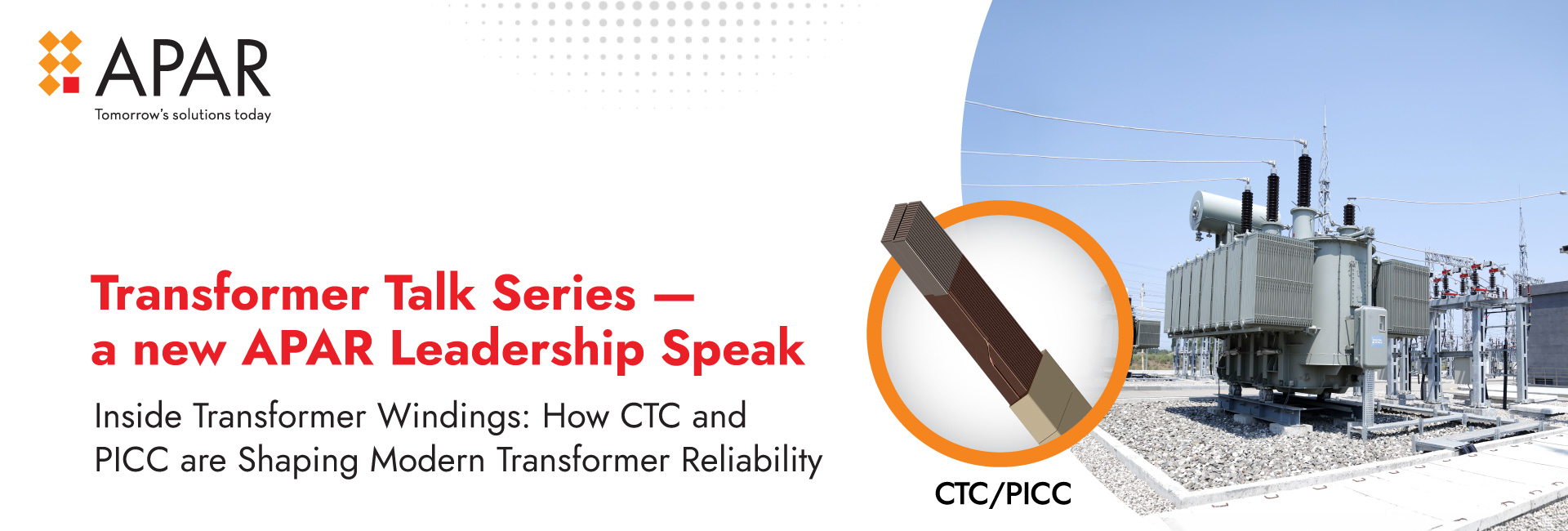
In this context, Continuous Transposed Conductors (CTC) is an advanced technology that has become integral to modern transformer design. Compared to conventional paper-covered conductors, they offer optimised current distribution, minimised eddy current and circulating losses, and superior dielectric performance. In addition to improving efficiency and reliability, the compact design of CTC allows more effective use of transformer space, reduces winding times, enables more compact transformer construction, and contributes to overall cost optimisation. CTC, has now been mandated by the CEA for transformer windings above 400 A.
Together, CTC and Paper Insulated Copper Conductors (PICC) embody the convergence of material science, engineering precision, and innovative design, providing critical enablers for high-performance, efficient, and future-ready power and distribution transformers.
APAR Industries has been at the forefront of conductor technology in India, combining advanced metallurgical know-how with precision engineering to deliver high-performance CTC and PICC solutions. With state-of-the-art manufacturing facilities, APAR ensures consistent strand quality, precise transposition, and stringent insulation application, which translates to reliable transformer operation under demanding conditions.
CTC – Engineering Efficiency for Power Transformers
Continuous Transposed Conductors are specifically designed to minimise eddy current losses and improve current distribution in transformer windings. A CTC consists of multiple rectangular enamelled copper strands, continuously transposed in a precise pattern and covered with suitable insulation material. This ensures that each strand occupies every possible position within the cross-section during one transposition cycle, equalising the magnetic environment for all strands.
Such design significantly reduces circulating currents and related losses, while improving current balance across the winding. The result is enhanced transformer efficiency, lower heat generation, and improved performance stability under high electrical and thermal stresses. These benefits are particularly critical for power transformers, where compact designs, higher current densities, and elevated voltage levels demand superior electrical characteristics and mechanical integrity.
Modern CTC manufacturing processes at APAR focus on precision in strand alignment, consistent insulation application, and dimensional accuracy. Advanced transposition technologies and automated control systems ensure uniformity and repeatability, both of which are vital for ensuring predictable behaviour under load variations. Additionally, the selection of insulation materials, such as paper or polyester, influences thermal performance and dielectric strength, enabling the conductor to meet diverse transformer design requirements.
PICC – Reliability for Distribution Transformers
While CTCs dominate power transformer applications, Paper Insulated Copper Conductors (PICC) remain the preferred choice for distribution transformers. The construction of a PICC involves wrapping high-conductivity copper with layers of electrical-grade kraft paper to achieve the desired insulation strength and thickness. This configuration offers excellent dielectric properties, moisture resistance, and mechanical robustness — features which are critical for reliable operation under varying load and climatic conditions.
In distribution networks, transformers are frequently subjected to cyclic loading and voltage fluctuations. The durability of PICCs under such conditions ensures long-term serviceability and reduced maintenance requirements. The uniformity of insulation wrapping, control of paper overlap, and precision in conductor geometry are crucial parameters determining the electrical and mechanical performance of PICCs.
Advancements in paper quality, wrapping techniques, and insulation drying methods have further improved the performance of these conductors. Modern PICCs are capable of withstanding higher electrical stresses while maintaining compact winding configurations, contributing to improved transformer efficiency and reduced material consumption.
Evolving Requirements and Industry Trends
The Indian power sector’s growing emphasis on efficiency and reliability has driven continuous innovation in conductor design and manufacturing. Transformer manufacturers are increasingly adopting advanced conductor types to meet stringent energy efficiency norms and operational reliability standards.
Key trends shaping the segment include:
- Higher Voltage and Power Ratings: Demand for ultra-high voltage and high-capacity transformers requires conductors with improved mechanical and thermal stability.
- Compact Designs: Optimised winding configurations necessitate conductors with precise dimensional tolerances and higher packing factors.
- Sustainability and Energy Efficiency: Reduction in losses through advanced conductor geometry directly contributes to lower carbon footprints and energy savings.
- Material Optimisation: Enhanced copper utilisation and insulation system improvements help balance performance with cost and weight considerations.
These trends underline the need for continuous R&D in conductor technologies, focusing on new insulation systems, improved metallurgical properties, and automation in production to achieve superior reliability and consistency.
Conclusion
The reliability and efficiency of a transformer depends fundamentally on the quality of its conductors. CTC and PICC technologies exemplify the critical interplay between material science, electrical design, and manufacturing precision. Their proper selection and application not only enhance equipment performance but also contributes meaningfully to the overall efficiency and resilience of the power system.
With India’s grid expanding in scale and complexity, the adoption of advanced conductor technologies represents a key step toward building a robust, energy-efficient, and future-ready power infrastructure.